Mitovo for running
A faster 10 km or a marathon PR comes from months of consistent weeks, not one heroic one. Mitovo plans your season to the race, builds your kilometres within limits set in code and paces every session from your own data.
Updated:
Consistency is the hard part
Most runners know what a good week looks like. What breaks a season is the week after: the long run that grew too fast, the intervals squeezed into a day that was already full, the easy runs that crept up to tempo, a niggle that turned into three weeks off. With a job and a life, the plan that works is the one that adapts when the week doesn’t go to plan.
Mitovo plans for that. It knows the time you have on each day, what you ran, how hard, and how you slept, and it replans the next two weeks every Sunday inside limits that code sets, not the AI model.
Your season, from today to race day
You add your race as a goal: 5 km, 10 km, half marathon, marathon or any distance, with its date, a target time if you have one, and a priority (A, B or C). Your coach proposes the season as blocks of a few weeks with weekly aims in hours, kilometres and runs; you accept it or say what should change.
- Kilometres that build within limits. Each build week aims at most about 10 % or 2 km above the one before, a recovery week follows every few build weeks, and the weekly kilometres never jump more than your running ramp allows (15 % by default, 10 % after a recent lower-limb injury).
- A taper by race length. One week before an A race from 5 km to the half marathon, two before a marathon; shorter for a B race.
- Every Sunday, the next two weeks, planned from what you ran, your recovery and the days you have. Easy runs that ran harder than planned show up in the look back.
- Strength alongside. Runs and strength sit in one week, and hard leg strength goes on another day than your key runs (strength).
How the season and the weekly review work: From season to session. How load and its limits work: training load. To try the numbers yourself: the race-time predictor and the training zones calculator.
Built for running
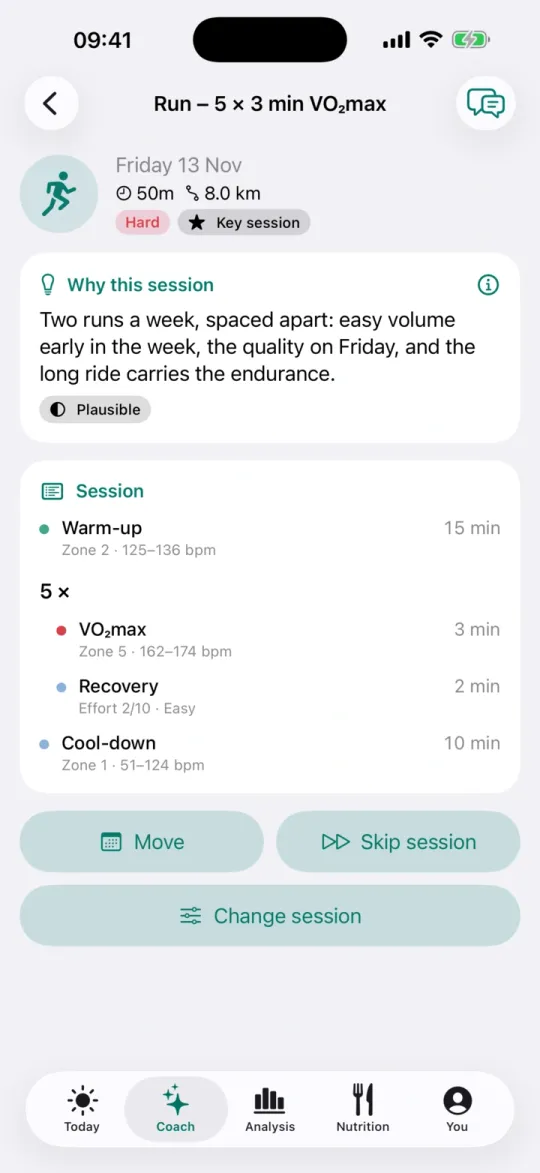
- Paces from your threshold. Mitovo estimates your threshold pace from your hard runs of 5 km or more (Riegel’s formula, the pace you could hold for about an hour), or you measure it with the 30-minute run test. Every run step gets a pace range around it, or its heart-rate zone without one (zones and tests).
- 17 classic running workouts, from run–walk, recovery runs and long runs with a marathon-pace finish to tempo runs, cruise intervals, sub-threshold repeats, 5 × 1000 m, 4 × 4 minutes, 30/30s, fartlek, hill repeats, Yasso 800s and 8 × 400 m. Each says what it trains, with three cues, and shows its steps at your paces. Build your own in the editor.
- On your Apple Watch. Planned runs go to the Workout app with their steps and targets; any library workout can go to the Watch at today’s paces.
- Race predictions and race targets. From your hard runs of the last 90 days, the Race targets card estimates your goal race and shows the gap to your target.
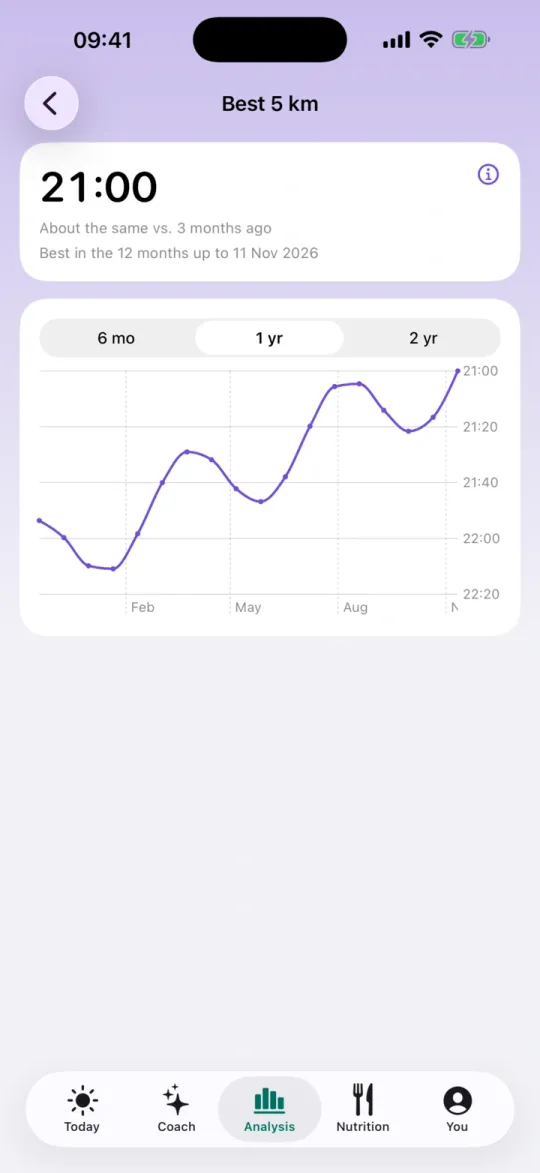
- Best efforts. Your fastest times over 400 m to the marathon from your outdoor runs, over 6 weeks to all time, with a second period to compare.
- A race plan for your A race. From eight weeks out: pacing for the start, the middle and the finish (a start 1–3 % slower than race pace, a finish up to 3 % faster when it still feels controlled), fuelling and fluids per hour by the race’s length, carb loading, the race-morning meal, the warm-up, and, before a marathon or longer, runs of 90 minutes or more that rehearse the fuelling.
- Running inside other sessions counts. The kilometres of a brick’s run or a Hyrox session’s runs count toward your running ramp, so a mixed week can’t hide a jump.
Injuries and niggles
Mitovo isn’t a medical app. When you log an injury, the plan honours its restrictions (for example, no running while it says so), and the running ramp stays at 10 % for a year after a lower-limb injury. For pain that doesn’t settle, see a doctor or a physiotherapist; after a serious injury the plan resumes once you’re cleared.
What Mitovo doesn’t do yet
- No running power targets. Running power from an imported FIT file shows on the workout, without zones; plans use pace and heart rate.
- No treadmill best efforts. A treadmill’s distance isn’t measured by the watch, so only outdoor runs count toward best efforts.
- No course profiles. Run pacing goes by start, middle and finish, not by where a course’s hills are.
- Trail and ultra estimates are optimistic. Predictions come from flat runs; beyond the marathon or on a hilly course the card’s estimate is the fastest possible, not a realistic time, and the card says so.
Questions
How fast does Mitovo increase my weekly kilometres?
By default by at most 15 % a week against the higher of your two weeks before, and by 10 % if you've had a lower-limb injury in the last 12 months. You can set your own value. Your longest run grows by at most 15 % or 15 minutes a week.
Along the season, each build week's aim is at most about 10 % or 2 km above the one before. These are limits, not targets: your coach plans inside them.
Where do my paces come from?
From your threshold pace: estimated from your recent hard runs of 5 km or more, or measured with the 30-minute run test. Each run step gets a pace range around it, and the library's workouts show their steps at your paces of that day.
Can Mitovo predict my race time?
It estimates it from your hard runs of the last 90 days with Riegel's race-time formula, shown on the Race targets card next to your target and how far apart they are. The estimate comes from flat runs and isn't corrected for distance beyond the marathon or for climbing, so for an ultra or a hilly race it's the fastest possible time: the card says so, and your coach reads it that way.
Does Mitovo send my runs to my watch?
Yes. Planned runs go to the Workout app on your Apple Watch with their steps and targets, and you can send any library workout to the Watch at today's paces.
What happens after my marathon?
About a week of easy training, with no hard session in the seven days after it. The plan check holds that line, and your season goes on toward your next goal.